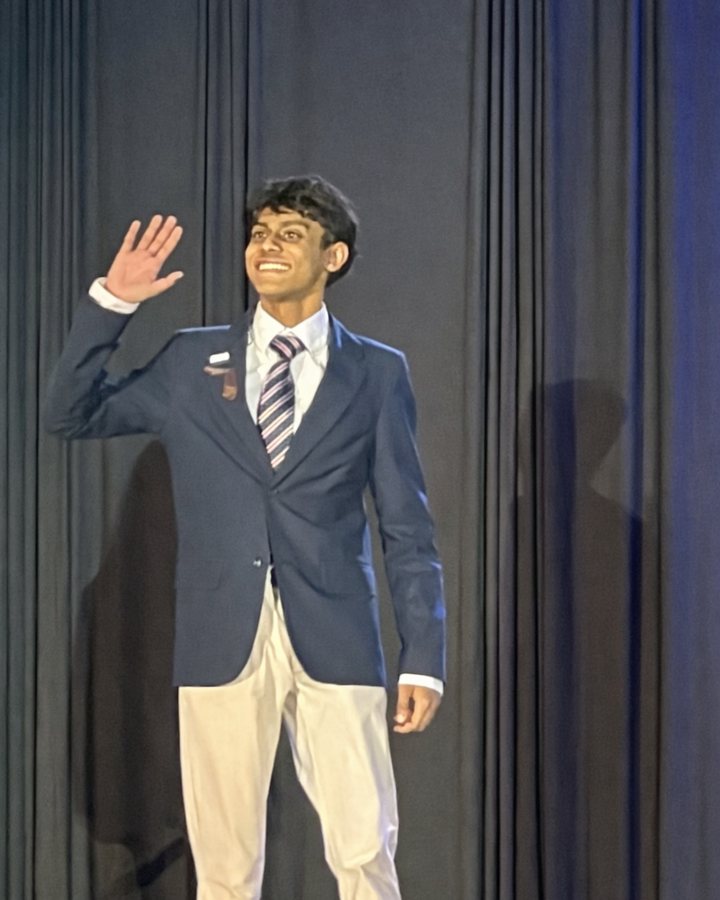
Rishab Suresh
Duke University
Electrical and Computer Engineering and Computer Science
Rishab is a three-time Best Delegate at various international Model UN conferences, including Princeton MUN and the North American Invitational MUN.
Podivm watches how you stand, gesture, and speak, then pinpoints the one change that will make the biggest improvement.
No account needed for the first take.
Practicing in the mirror is both awkward and ineffective. Podivm shows you exactly what to fix, no mirror or audience required.
Stance, posture, and gestures, tracked point by point, so you command the room's attention before you say a word.
Podivm tracks your speaking pace, how you vary pitch & volume, and counts the filler words that get in the way.
Podivm tracks your eyes and head, so you stay focused on your audience.
Every practice session ends with the one fix that will move the needle most.
Podivm adapts your feedback to your audience and occasion.
You know your answers. Practice saying them to a camera, not just in your head.
Your slides are done. Make sure you can explain them clearly.
You've got the words. Master every pause and expression before anyone is listening.
Duke University
Electrical and Computer Engineering and Computer Science
Rishab is a three-time Best Delegate at various international Model UN conferences, including Princeton MUN and the North American Invitational MUN.

Duke University
Economics, Political Science, and Entrepreneurship
Ekansh is a three-time Speech and Debate Nationals competitor in extemporaneous public speaking and a two-time regional champion.
Focus: slow down
Practice in front of your webcam or phone.
Podivm analyzes your body language and spoken content, and marks where you rushed, looked away, or said “um.”
Follow a short drill for the biggest issue, then record again and see the difference.
No. The camera and microphone are read inside the tab: body language, voice and scoring all run there, the recording is dropped when you close the page, and it is never uploaded. One part of a take does leave your device, and it is the words. Chrome transcribes through Google's speech service and Edge through Microsoft's; on Firefox, Safari and Brave a small Whisper model reads the audio in the tab instead. Podivm itself stores no transcript, and the privacy page names every company that holds a copy of anything.
It measures pace in words a minute, filler and hedging words per hundred, how much of the take your head is turned toward the lens, how still you stand, how much your pitch and volume move, how often you gesture, and a set of counts about the words themselves. It cannot measure eye contact. A webcam sees the direction of your head, not your eyes. It cannot tell you whether your argument is right. Neither is reported rather than guessed at, and the report names what it could not measure.
The first take is forty-five seconds and asks one question: tell me about yourself. After that a drill runs three to five minutes, and the plan is built around the time you said you have: five, ten, twenty or thirty minutes a day.
A browser and a camera. Any webcam or phone camera works, and so does the microphone built into it. A quiet room helps the voice measurements and the words; a noisy one costs you those bars for that take, not the whole report, and the missing count says so.
The first cycle is free: the quiz, a baseline recording, the plan it builds from that take, and one check-in. Podivm Pro is $25 a month, and $12.99 a month while we are launching, or $120 a year: every lesson in the library, every track, and a check-in whenever you want one. There is no card until you choose Pro.
Rishab Suresh and Ekansh Rastogi, two students at Duke. Rishab is a three-time Best Delegate at international Model UN conferences; Ekansh competed at Speech and Debate Nationals three times in extemporaneous speaking. The bars come from a trained model and from cut points in the analysis code, and a bar with no reading behind it is shown as unmeasured.